Artificial intelligence is changing how businesses access information, automate processes, and make decisions. From customer support assistants to internal knowledge systems, organizations are increasingly using generative AI to help employees work with large amounts of information. However, enterprise AI faces a fundamental challenge: how can an AI system provide useful answers based on a company's […]
Artificial intelligence is changing how businesses access information, automate processes, and make decisions. From customer support assistants to internal knowledge systems, organizations are increasingly using generative AI to help employees work with large amounts of information.
However, enterprise AI faces a fundamental challenge: how can an AI system provide useful answers based on a company’s own information rather than relying only on its general training data?
A company’s most valuable knowledge often exists in internal documents, product manuals, policies, project reports, customer records, and operational databases. A general-purpose AI model may not have access to this information, and retraining the model whenever company information changes is not always practical.
This is where Retrieval-Augmented Generation (RAG) becomes important.
RAG connects generative AI models with relevant external knowledge sources, allowing them to retrieve information and use it when generating responses. For businesses, this creates opportunities to build AI applications that understand organizational context, provide more relevant answers, and help employees access information more efficiently.
In this article, we explore what RAG is, how it works, its benefits for enterprise AI, and what businesses should consider before implementing it.
What Is Retrieval-Augmented Generation (RAG)?
Retrieval-Augmented Generation, commonly known as RAG, is an AI architecture that combines information retrieval with generative AI.
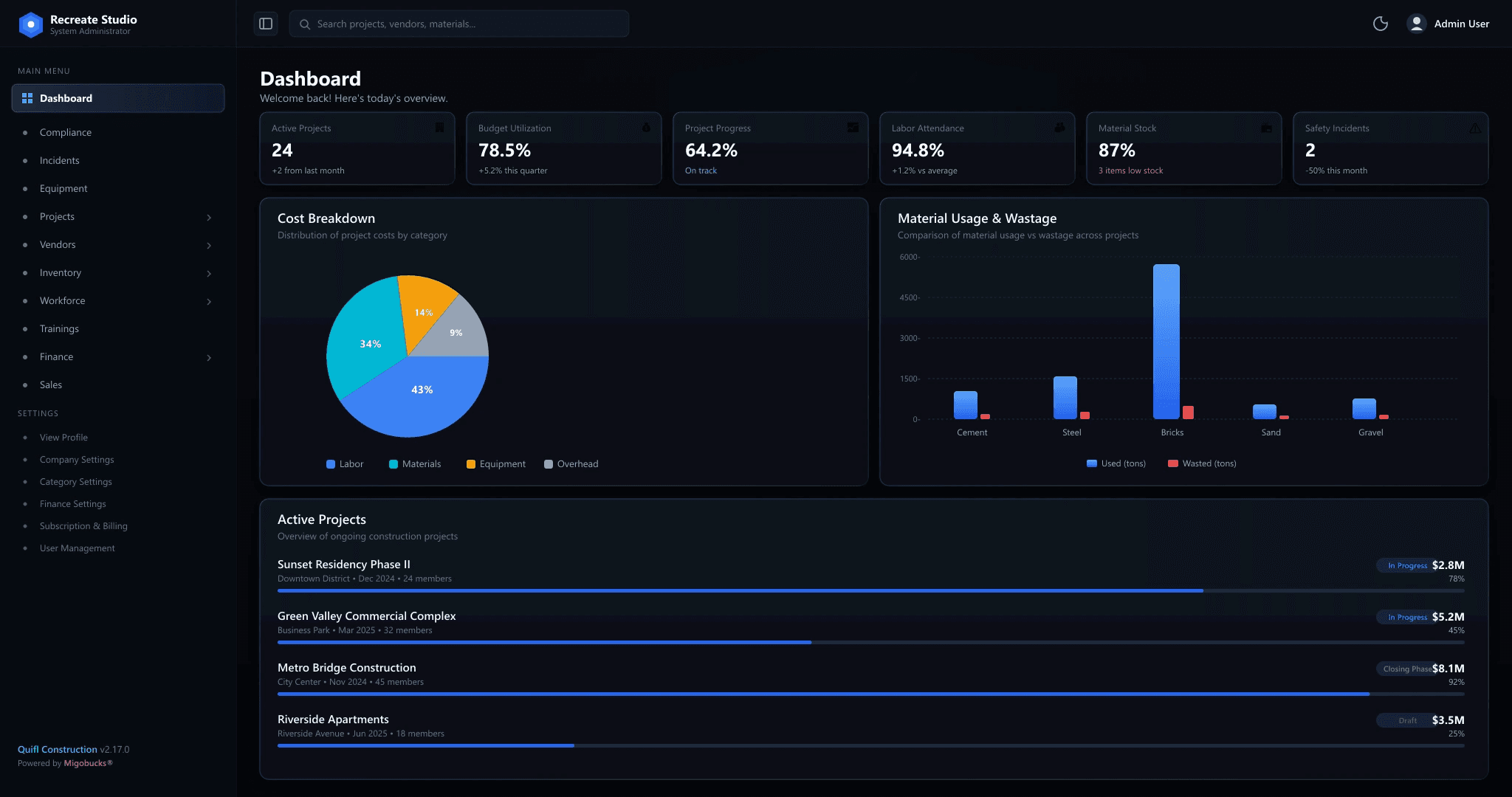
In simple terms, RAG allows an AI model to search a knowledge source for relevant information before generating an answer.
A traditional large language model (LLM) generates responses using patterns and information learned during training, along with the context provided in the current conversation. It does not automatically know the latest details stored in a company’s private systems.
A RAG-based application adds a retrieval layer. When someone asks a question, the system searches approved knowledge sources, retrieves relevant information, and provides that information to the language model as context.
For example, imagine an employee asking:
“What is our company’s process for approving a purchase request above ₹1 lakh?”
A general AI model might provide a generic procurement procedure. A RAG-enabled enterprise assistant can search the company’s actual procurement policy and use the relevant section to formulate its answer.
The response can also include a reference to the source document so the employee can verify the information.
RAG does not retrain the underlying language model whenever documents change. Instead, it supplies relevant external information at the time of a query, provided that the knowledge source and its index have been updated appropriately.
This makes RAG particularly useful for organizations working with proprietary, frequently changing, or domain-specific information.
How Does RAG Work?
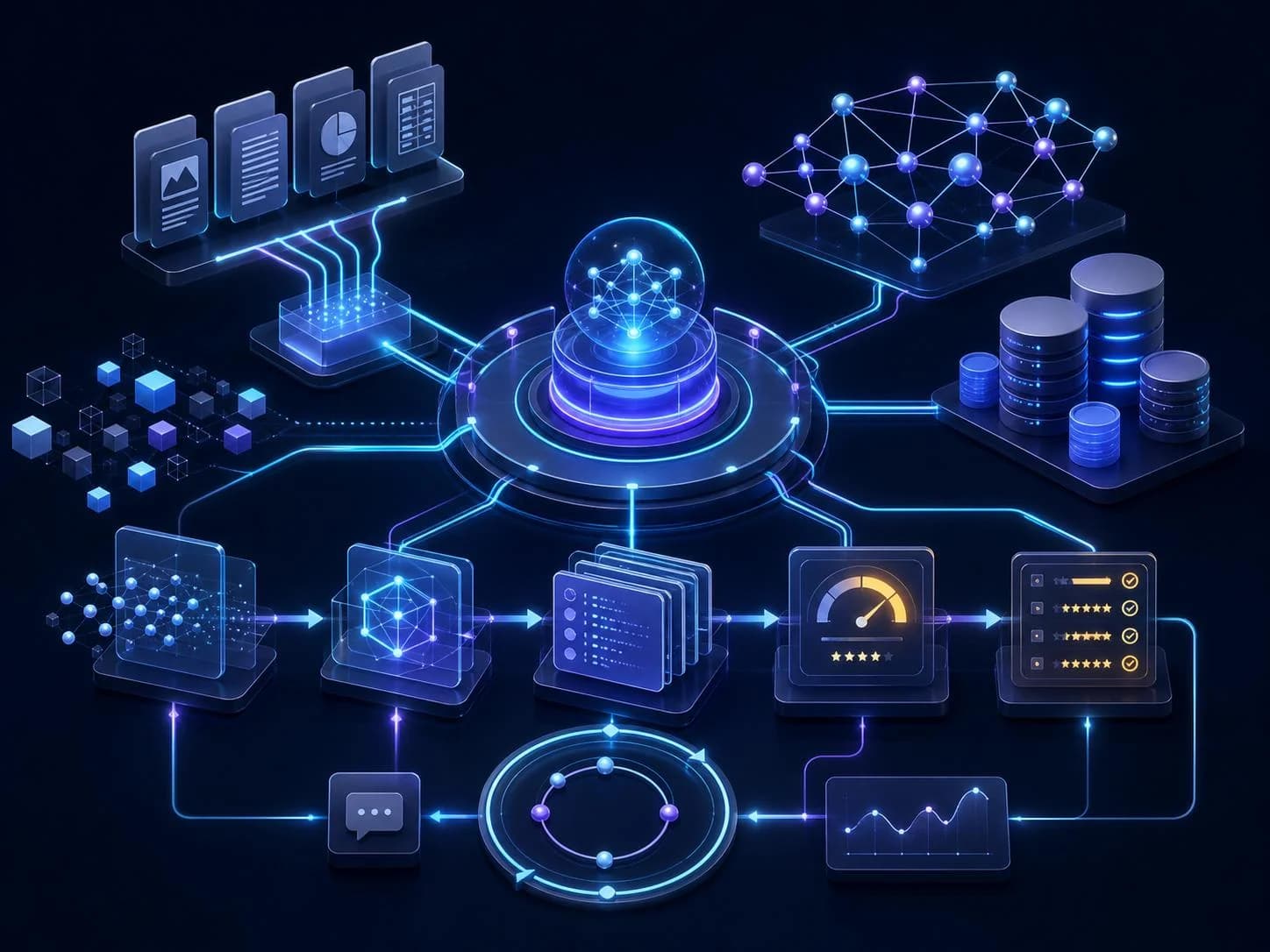
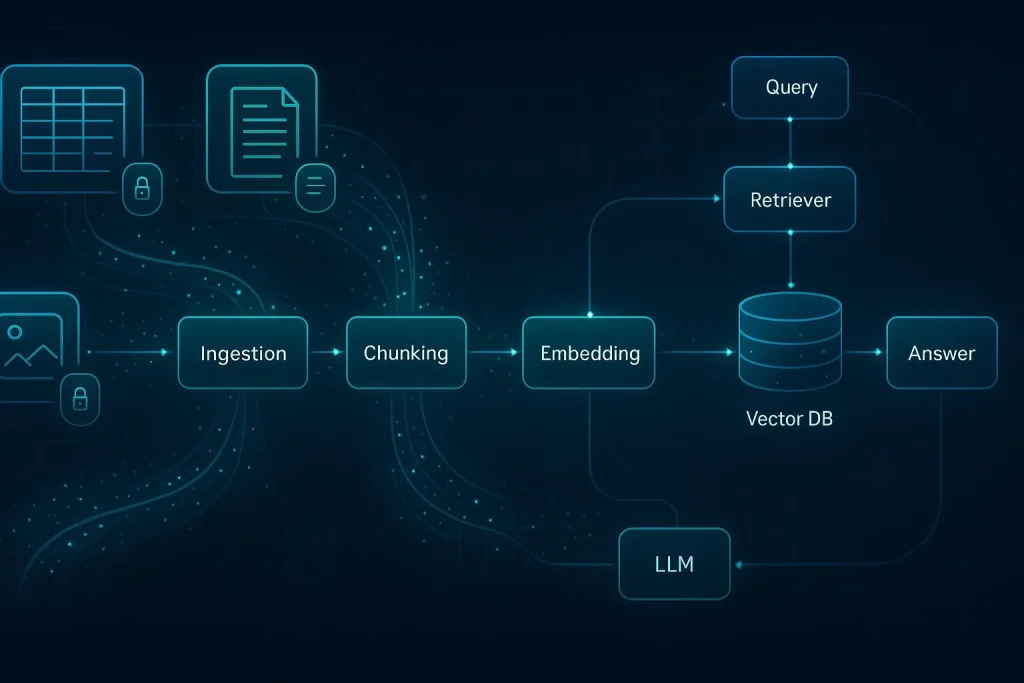
A typical RAG system consists of two connected workflows: preparing the knowledge base and answering user questions.
1. Collecting and preparing enterprise data
The process begins by identifying the information sources the AI application is allowed to use.
These sources may include:
- Internal policies and standard operating procedures.
- Product documentation and user manuals.
- PDF reports, Word documents, and spreadsheets.
- Frequently asked questions and support tickets.
- Approved project documentation.
- Structured business data accessed through appropriate integration’s.
Before this information is indexed, the system must extract the content, remove unnecessary duplication, preserve useful document structure, and attach relevant metadata such as document title, department, version, and access permissions.
Poor-quality source data can undermine the entire application, regardless of which AI model is used.
2. Breaking documents into smaller sections
Large documents are usually divided into smaller sections called chunks.
For example, a 100-page employee handbook might be divided into sections covering leave policies, payroll, travel reimbursement, and employee benefits.
This makes it easier to retrieve the relevant passage instead of providing the entire handbook to the language model.
Chunk size and overlap need to be selected carefully. Very small chunks can lose context, while very large chunks may contain unrelated information and increase processing costs.
3. Creating embeddings and indexing information
Many RAG systems use embeddings to support semantic search.
An embedding is a numerical representation of information that captures aspects of its meaning. An embedding model converts document chunks into vectors, which can then be indexed for similarity-based retrieval.
This allows the system to identify conceptually related content even when the wording of a user’s question differs from the wording in the document.
For example, a user might ask, “How do I claim money spent on a business trip?” while the company document uses the heading “Travel Expense Reimbursement Policy.”
Semantic search can help connect these different expressions.
A vector database or search engine stores and indexes the information needed for retrieval. Depending on the application, the system may combine vector search with keyword search and metadata filters to improve relevance.
4. Retrieving relevant information
When a user submits a question, the retrieval component searches the indexed knowledge base for relevant passages.
The system may first improve or interpret the query, apply access-control filters, and retrieve a set of candidate passages. A ranking component can then prioritize the most relevant results.
The objective is to supply the language model with useful evidence rather than an arbitrary collection of documents.
5. Generating a grounded response
The system combines the user’s question with the retrieved information and sends the resulting context to the language model.
The model uses this context to produce a natural-language response. The application can also provide source references, document links, or excerpts so users can check the answer.
A well-designed system should be able to acknowledge when the retrieved evidence is insufficient instead of confidently inventing an answer.
The overall workflow is:
Enterprise data → Document processing → Chunking and indexing → Information retrieval → Context augmentation → AI-generated response
Each stage affects the quality of the final result. RAG is not simply a connection between a chat bot and a database; it is a complete information retrieval and response-generation pipeline.
Why Is RAG Important for Enterprise AI?
RAG addresses several practical challenges organizations encounter when deploying generative AI.
1. Access to company-specific knowledge
General-purpose AI models do not automatically have access to an organization’s internal documentation or proprietary business information.
RAG allows an application to retrieve relevant information from approved company sources without requiring the underlying model to be retrained on every internal document.
This is useful for organizations that need AI assistants to answer questions about their own products, processes, policies, and services.
For example, a software company could use RAG to help its support team retrieve the correct product instructions, troubleshooting procedures, and feature documentation.
2. More relevant and verifiable responses
A language model may generate a fluent answer that is not supported by the facts. This behavior is commonly associated with AI hallucinations.
RAG can reduce this risk by providing relevant source material for the model to use when answering a question.
It also makes source attribution possible. Instead of presenting an answer without context, an enterprise assistant can link to the document or policy supporting its response.
However, RAG does not eliminate hallucinations. The system may retrieve the wrong passage, overlook important information, or interpret evidence incorrectly. Retrieval quality, response validation, and source citations must therefore be tested.
3. Access to changing information
Business information changes frequently.
Companies introduce new policies, revise product features, update prices, modify workflows, and publish new documentation. A model’s original training data may not reflect these changes.
With RAG, updated information can become available through the knowledge pipeline without retraining the underlying language model, although document processing and index refreshes may still be required.
This is especially valuable for internal knowledge assistants, product support systems, and operational documentation.
4. Better employee productivity
Employees often spend time searching across folders, documents, knowledge portals, and different business applications to find answers.
A RAG-enabled assistant can provide a single interface for asking questions across authorized information sources.
For example, an employee preparing a project review might ask for the latest project scope, relevant delivery procedures, and documentation requirements. The assistant can retrieve information from the connected sources and summarize it in one response.
The potential benefit is reduced search effort and faster access to organizational knowledge. Actual productivity improvements depend on retrieval quality, user adoption, and the usefulness of the underlying information.
5. A foundation for enterprise AI applications
RAG can support more than a general-purpose question-answering chat bot.
Organizations can use it to build:
- Internal knowledge assistants.
- Customer support and product documentation assistants.
- HR policy assistants.
- Technical troubleshooting tools.
- Contract and document review assistants.
- Project documentation search.
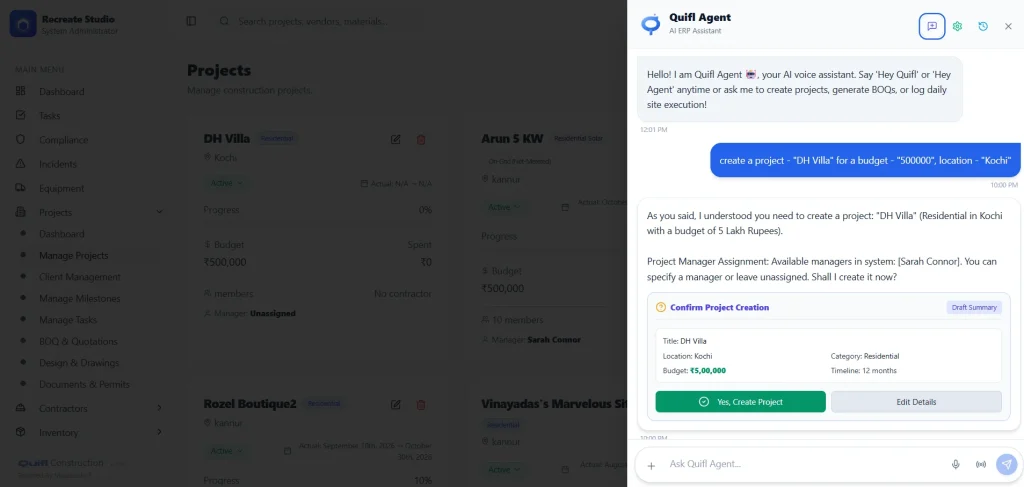
- AI assistants connected to ERP and CRM information.
These applications become particularly valuable when they can retrieve the right information while respecting user permissions and business rules.
Real-World Enterprise Use Cases for RAG
RAG in ERP systems
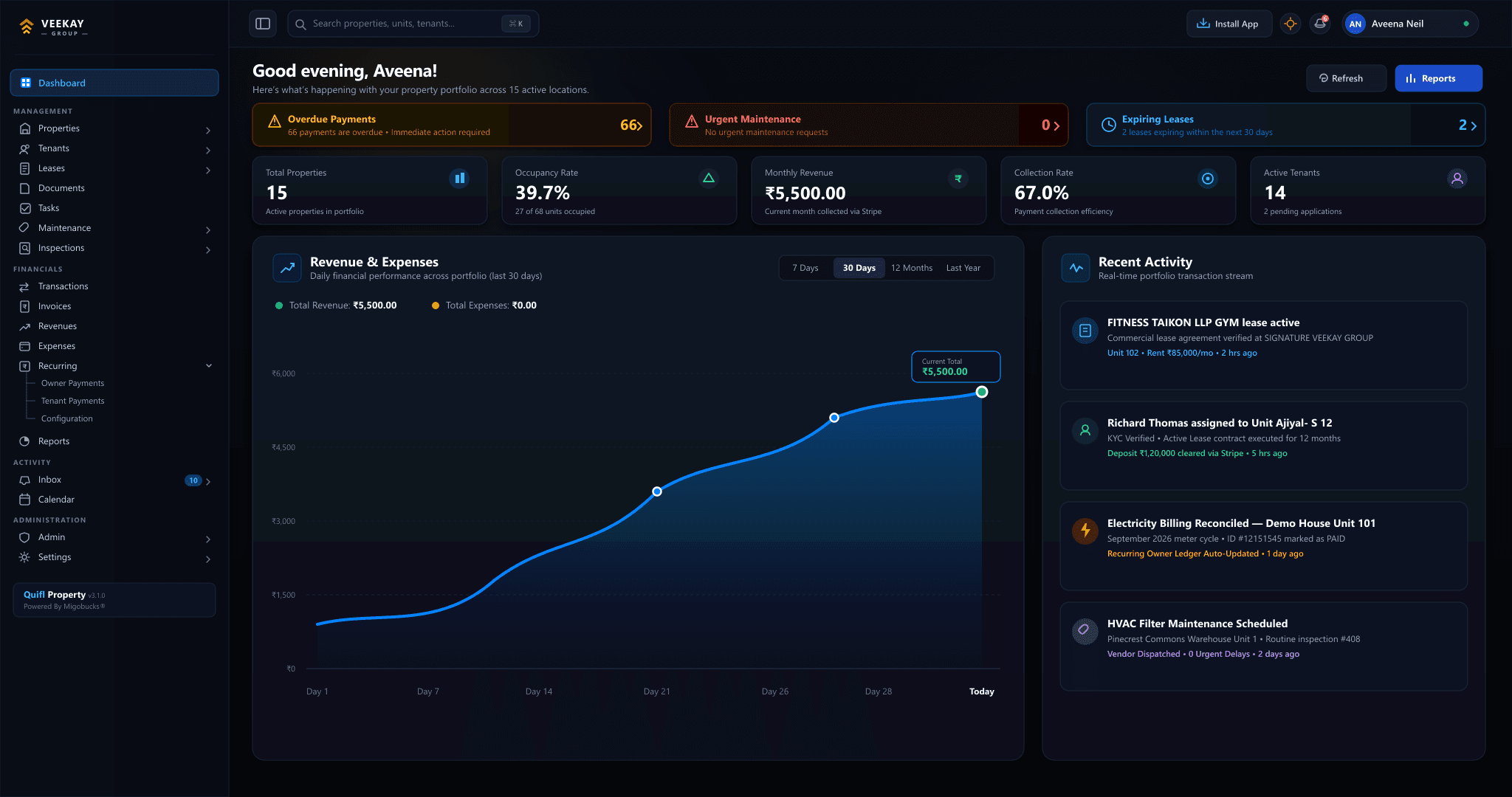
Enterprise resource planning (ERP) systems contain information about finance, inventory, procurement, sales, and operations.
A RAG-enabled assistant could help an authorized employee ask questions such as:
“Which purchasing policy applies to this request?”
“What does the procedure say about recording received materials?”
“Where can I find the documentation requirements for a project milestone?”
The assistant retrieves relevant policies and documentation, explains the applicable process, and links to the source.
For questions involving live stock balances, outstanding invoices, or current financial totals, a system may need to query structured databases or approved business APIs rather than relying exclusively on a document index.
This distinction is important: RAG helps retrieve and explain information, but it does not replace the transactional logic of an ERP system.
RAG in customer support
A support team may maintain product manuals, release notes, troubleshooting guides, and historical support documentation.
A RAG-based assistant can search these sources to recommend relevant troubleshooting steps and draft responses for support agents.
This helps employees access consistent documentation without manually searching multiple files.
The system should prioritize current, approved documentation and escalate cases when the evidence is incomplete or a problem requires human investigation.
RAG in human resources
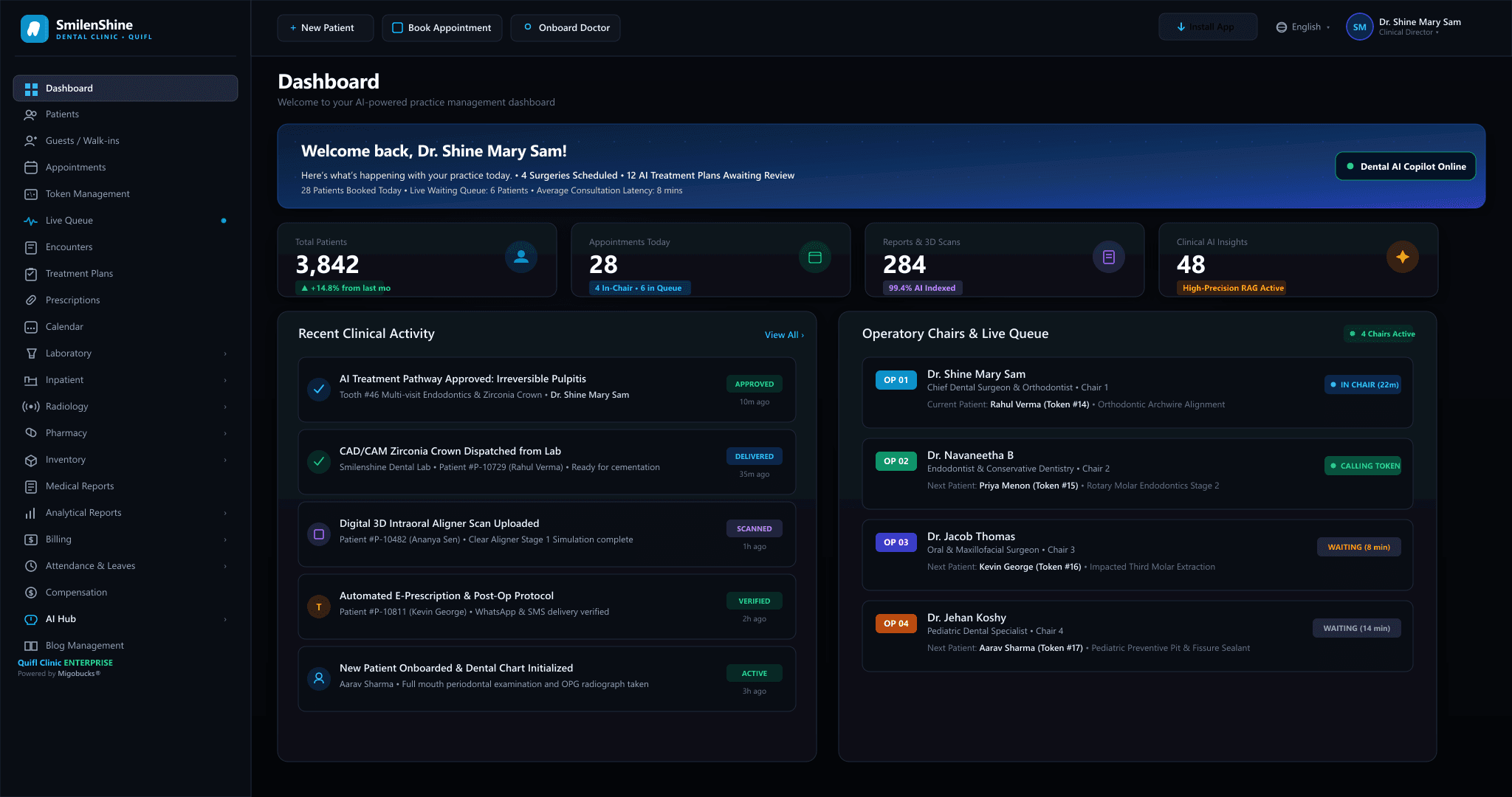
HR teams regularly answer questions about leave, attendance, reimbursement, employee benefits, and internal policies.
A RAG assistant can retrieve the relevant policy section and explain the procedure to employees.
For instance, an employee asking about a reimbursement deadline could receive an answer based on the current approved policy, along with a link to the original document.
Personal employee records require a different level of protection. Access to private information must be checked against the employee’s identity and authorization before any relevant data is retrieved.
RAG in project management
Project teams manage proposals, technical specifications, meeting notes, site reports, drawings, and project procedures.
A RAG-enabled assistant can help users locate project-specific requirements, summarize documentation, and identify relevant references.
For example, a project manager could ask which document defines the acceptance criteria for a particular milestone.
The assistant can retrieve the relevant specification and provide a summary with a source reference. However, current completion status or approved milestone values should come from authoritative project records, not an unverified document summary.
RAG vs. Fine-Tuning: What Is the Difference?
RAG and fine-tuning are different approaches to adapting AI applications to a particular use case.
| Factor | RAG | Fine-tuning |
|---|---|---|
| Primary purpose | Supplies relevant external information at query time | Adapts a model’s behavior through additional training |
| Changing company documents | Can use updated sources after the knowledge pipeline refreshes | Changes to source knowledge may require further training or another update mechanism |
| Source references | Can support citations to retrieved documents | Does not inherently provide citations to source documents |
| Typical use cases | Enterprise knowledge retrieval and document question-answering | Consistent output formats, specialized task behavior, or domain-specific response patterns |
| Key dependency | Source quality and retrieval performance | Training data quality and training effectiveness |
The approaches are not mutually exclusive.
RAG is often a good starting point when the main requirement is to answer questions using current company information. Fine-tuning may be useful when a model needs to learn a particular response style or perform a specialized task more consistently.
Some applications use both techniques.
The choice should be driven by the business requirement, available data, performance expectations, cost, and operational constraints.
What Are the Challenges of Implementing RAG?
Although RAG offers significant potential, building a reliable enterprise application requires careful planning.
Data quality and document freshness
Outdated policies, duplicate files, missing content, and inconsistent document versions can lead to incorrect answers.
Organizations need clear document ownership, version control, and procedures for updating or removing indexed content.
Retrieval accuracy
If the system retrieves irrelevant passages or misses the correct information, the language model may produce an incomplete response.
Teams should evaluate query interpretation, chunking, search methods, ranking, and metadata filtering using representative business questions.
Security and access control
Enterprise knowledge bases may contain confidential financial information, employee records, customer data, and intellectual property.
A secure system must enforce permissions during retrieval, not merely hide sensitive information in the final response. A user should never receive content simply because it exists in the knowledge base.
For software platforms serving multiple organizations, tenant isolation is also critical. Each customer must be restricted to its own authorized information.
Cost and performance
RAG introduces additional processing, search, storage, and model-inference costs. Large retrieved contexts can increase latency and token consumption.
Organizations should monitor retrieval performance, response time, operating costs, and usage patterns to keep the solution practical at scale.
Evaluation and governance
A system that performs well in a small demonstration may fail on ambiguous questions, conflicting documents, or unusual user requests.
Businesses should test retrieval relevance, answer correctness, citation accuracy, access permissions, and behavior when evidence is insufficient.
RAG also introduces risks such as malicious instructions embedded in retrieved documents. Retrieved content should be treated as untrusted data, with appropriate safeguards against prompt injection and unauthorized downstream actions.
How Businesses Can Get Started With RAG
A practical implementation should begin with a clearly defined business problem rather than a decision to adopt AI for its own sake.
Step 1: Select a focused use case. Start with a bounded problem, such as answering questions about product documentation or retrieving approved internal procedures.
Step 2: Identify the authoritative data sources. Determine which documents, databases, and repositories contain the information required to answer the target questions.
Step 3: Assess data quality and permissions. Check document accuracy, ownership, duplication, sensitivity, and access restrictions.
Step 4: Design the retrieval pipeline. Choose appropriate extraction, chunking, embedding, indexing, search, and ranking methods based on the nature of the information.
Step 5: Integrate the language model. Supply retrieved passages as context and configure the application to provide useful source references and acknowledge insufficient evidence.
Step 6: Test with real business questions. Evaluate the application using expected questions, ambiguous queries, outdated documents, conflicting sources, and unauthorized access attempts.
Step 7: Measure results and improve. Track answer quality, retrieval relevance, response time, user feedback, security incidents, and cost per query. Use these findings to refine the system before expanding it.
Business analysts can play an important role throughout this process by documenting user needs, mapping information flows, defining access and business rules, coordinating stakeholder expectations, and establishing measurable acceptance criteria.
The Future of RAG in Enterprise AI
RAG is evolving alongside improvements in search technology, language models, enterprise data platforms, and AI agents.
More advanced systems can combine semantic search, keyword retrieval, structured database queries, re-ranking, and other methods to improve the relevance of retrieved information.
RAG can also serve as a knowledge layer for AI agents. An agent may retrieve an approved policy, use that information to plan a task, and interact with connected business systems under defined permissions.
These capabilities create opportunities for more context-aware enterprise applications. However, the complexity of the system also increases the importance of monitoring, security, reliable data, and clear authorization boundaries.
The most effective implementations will focus on solving measurable business problems rather than adding AI features without a defined purpose.
Conclusion
Retrieval-Augmented Generation is an important architecture for enterprise AI because it allows generative models to use relevant information from external knowledge sources when answering questions.
By connecting AI models to company documentation, policies, and other authorized data, RAG can improve contextual relevance, support source verification, and make organizational knowledge easier to access.
However, reliable results depend on more than the language model. Businesses need well-maintained information, effective retrieval, appropriate access controls, systematic evaluation, and clear governance.
For organizations exploring AI adoption, RAG provides a practical way to connect generative AI with existing business knowledge without retraining the model whenever information changes.
At Migobucks Tech, understanding technologies such as RAG is part of understanding how AI can be integrated into real business processes to make enterprise systems more connected, useful, and information-driven.
Suggested further reading
Related Topics
Share this post

Aravind
Published on October 21, 2026 • 14 min read
Discussion 0
No comments yet
Be the first to share your thoughts and join the conversation.
Leave a Comment
Your email address will not be published. Required fields are marked *