Artificial intelligence has been part of business conversations for years. But something changed when generative AI became widely accessible. Instead of using AI only behind the scenes for recommendations, predictions, fraud detection, or data analysis, people could suddenly ask an AI system to write an email, summarize a document, create an image, explain a complex […]
Artificial intelligence has been part of business conversations for years.
But something changed when generative AI became widely accessible.
Instead of using AI only behind the scenes for recommendations, predictions, fraud detection, or data analysis, people could suddenly ask an AI system to write an email, summarize a document, create an image, explain a complex topic, analyze information, generate code, brainstorm ideas, or turn a rough instruction into a finished piece of work.
That changes the conversation.
AI is no longer only something that technology teams build into software.
It can become something employees interact with directly.
This is why generative AI has attracted so much attention from businesses.
But there is an important distinction between using an AI tool and using generative AI effectively as part of a business.
Generative AI can create significant value, but it also introduces new questions around accuracy, privacy, intellectual property, security, governance, and human oversight.
So what exactly is generative AI?
And more importantly:
How is it changing the way businesses work?
Quick Answer: What Is Generative AI?
Generative AI is a type of artificial intelligence that can generate new content based on patterns learned from data and instructions provided by users or systems.
That content can include:
- Text
- Images
- Audio
- Video
- Code
- Summaries
- Structured information
- Other forms of digital content
Generative AI systems can respond to prompts and produce outputs that resemble the patterns and structures present in their training or contextual information.
For businesses, this means AI can move beyond simply analyzing information toward helping create, transform, summarize, organize, and interact with information.
That is one of the reasons generative AI is becoming relevant across so many business functions.
Why Is Generative AI Different From Traditional AI?
Artificial intelligence is a broad field.
Generative AI is one category within it.
Traditional AI applications may be designed to:
- Predict
- Classify
- Detect
- Recommend
- Optimize
- Identify patterns
For example, an AI system might analyze customer behavior and predict which customers are more likely to purchase a product.
Generative AI can take a different role.
It might use customer information and instructions to help create:
- A sales email
- A product description
- A summary
- A customer response
- A report draft
A simplified comparison is:
| Traditional AI | Generative AI |
|---|---|
| Predicts outcomes | Generates content |
| Classifies information | Creates or transforms information |
| Detects patterns | Produces new outputs |
| Recommends actions | Can help produce responses or ideas |
| Often task-specific | Can support many content-oriented tasks |
The distinction is not absolute. Modern AI systems can combine these capabilities.
But the difference helps explain why generative AI feels different to everyday business users.
How Does Generative AI Work?
You do not need to understand the mathematics behind an AI model to understand its business value.
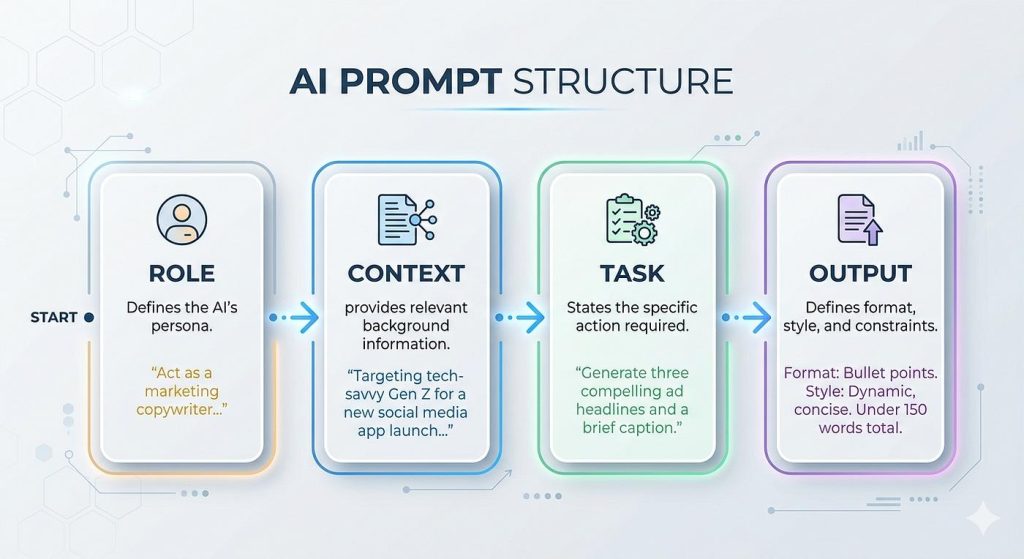
At a high level, a generative AI system receives an instruction or prompt, processes that request using a trained model and available context, and produces an output.
For example:
Prompt:
“Summarize this customer feedback and identify the three most common complaints.”
The system processes the information and generates a response.
A business workflow might therefore look like:
Business Information → Prompt/Instruction → AI Model → Generated Output → Human Review → Business Action
The important part is that the AI output does not automatically become a business decision.
A responsible workflow can include human review, validation, business rules, and appropriate controls.
This becomes particularly important when AI is used with sensitive or business-critical information.
Why Are Businesses Paying Attention to Generative AI?
The interest is not only theoretical.
McKinsey’s 2025 global survey reported that 71% of respondents said their organizations were regularly using generative AI in at least one business function. Marketing and sales were among the most common areas of use across the industries covered by the survey.
That does not mean every business has successfully transformed through AI.
Adoption and value are two different things.
A company can give employees access to an AI tool without changing any meaningful business process.
The more interesting question is:
Where can generative AI actually improve the way work gets done?
How Is Generative AI Changing Business?
Generative AI is influencing business in several ways.
Some changes are small.
Others could fundamentally change how certain types of knowledge work are performed.
Let’s look at the most important areas.
1. Content Creation
Content creation is one of the most obvious applications of generative AI.
Businesses constantly create:
- Marketing copy
- Blog articles
- Social media content
- Product descriptions
- Emails
- Presentations
- Internal communications
- Campaign ideas
- Video scripts
Generative AI can help create initial drafts, variations, outlines, summaries, and ideas.
For a marketing team, this can reduce the time between:
Idea → Draft → Review → Final Content
But there is an important caveat.
AI-generated content still needs human direction.
A business should not simply publish whatever an AI produces.
Brand voice, factual accuracy, originality, context, and audience relevance still matter.
The strongest model is often:
Human strategy + AI assistance + Human review
rather than:
AI generates everything → Publish
2. Customer Service
Customer service teams handle a large amount of repetitive information.
Customers may ask:
- How does this product work?
- Where is my order?
- How do I reset something?
- What are your policies?
- What documents do I need?
- What happens next?
Generative AI can help draft responses, summarize conversations, retrieve information, and assist support teams.
It can also help turn a long conversation into a short summary for the next employee who handles the case.
The value is not necessarily replacing the support team.
It can be about reducing the time employees spend searching, reading, and writing routine responses.
For complex, sensitive, or unusual cases, human involvement remains important.
3. Sales and Marketing
Sales teams spend a significant amount of time researching prospects, preparing communication, updating records, and creating proposals.
Generative AI can assist with:
- Prospect research
- Email drafting
- Proposal preparation
- Meeting summaries
- Customer communication
- Sales content
- Product explanations
- Follow-up suggestions
For example, after a customer meeting, an AI system could potentially summarize the discussion and identify follow-up actions.
Instead of the salesperson spending significant time reconstructing the meeting manually, the AI can provide a starting point for review.
McKinsey’s research has identified marketing and sales as particularly active areas for generative AI adoption, reflecting the large amount of content and communication involved in these functions.
4. Knowledge Management
One of the less obvious but potentially important applications is internal knowledge.
Businesses accumulate enormous amounts of information:
- Policies
- Procedures
- Product documentation
- Contracts
- Reports
- Training materials
- Meeting notes
- Technical documents
- Internal knowledge bases
Finding the right information can take time.
Generative AI can provide natural-language interfaces for interacting with organizational information.
Instead of searching through several documents, an employee might ask:
“What is our process for handling this type of customer request?”
The AI could retrieve relevant information and provide a concise response, depending on how the underlying system is designed.
This creates an important opportunity:
Turning organizational information into something employees can interact with conversationally.
5. Document Processing
Businesses deal with large volumes of documents.
These might include:
- Invoices
- Contracts
- Applications
- Forms
- Reports
- Emails
- Proposals
- Customer documents
Generative AI and related AI technologies can help extract information, summarize documents, classify content, and identify relevant sections.
For example:
Long Contract → AI Summary → Key Terms → Human Review
The AI does not necessarily replace the legal or business professional.
It can reduce the amount of time spent locating and summarizing information.
6. Software Development
Generative AI is also changing software development.
Developers can use AI systems to assist with:
- Code generation
- Code explanation
- Debugging
- Documentation
- Test generation
- Refactoring
- Prototyping
- Technical research
This can accelerate certain parts of development.
But generated code still requires review.
Software has to work correctly, securely, maintainably, and within the requirements of the system.
AI can accelerate development.
It does not remove the need for engineering discipline.
7. Business Research and Analysis
Business professionals often spend hours collecting and organizing information.
Generative AI can assist with:
- Summarizing research
- Comparing information
- Identifying themes
- Structuring notes
- Creating initial reports
- Generating questions for further research
- Explaining complex concepts
The important phrase here is assist with.
AI-generated analysis should not automatically be treated as authoritative.
Important claims, figures, legal information, financial information, and business-critical conclusions should be verified against reliable sources.
8. Employee Productivity
Perhaps the broadest impact of generative AI is personal productivity.
An employee can use AI as a kind of digital assistant for certain knowledge tasks.
For example:
Before
Research → Notes → Outline → Draft → Edit → Summary
With AI assistance
Research → AI-assisted organization → Draft → Human review → Final output
The employee still owns the result.
The AI reduces some of the friction involved in getting there.
This is especially useful for tasks that require transforming information from one form into another.
9. Product and Service Development
Generative AI can also influence how companies develop products and services.
Teams can use it to:
- Brainstorm ideas
- Explore concepts
- Create prototypes
- Generate user scenarios
- Analyze feedback
- Develop documentation
- Create early product specifications
This can shorten the distance between:
Idea → Concept → Prototype → Feedback
The important point is that AI can increase the number of ideas and iterations a team can explore.
Human judgment is still required to determine which ideas are actually valuable.
10. Personalization
Businesses often want to personalize customer experiences.
Generative AI can help create more context-aware communication.
For example:
A generic message might say:
“Thank you for contacting us.”
A more contextual system could generate a response based on:
- Customer history
- Previous conversations
- Product information
- Current request
- Business rules
However, personalization must be implemented carefully.
The more customer information an AI system uses, the more important privacy, access control, data governance, and security become.
Is Generative AI the Same as Business Automation?
Business automation typically follows predefined workflows and rules.
For example:
If invoice is approved → update payment status → notify finance
Generative AI works differently.
It can interpret and generate information.
For example:
Read customer message → understand the request → draft an appropriate response
The two technologies can also work together.
Consider:
Customer Message → AI Understands Message → Automation Applies Business Rules → Task Assigned → Employee Notified
This is where AI begins to become part of an intelligent business workflow.
We explored traditional business automation in our earlier articles:
- What Is Business Automation?
- 10 Business Processes That Can Be Automated
The next stage is understanding how AI can extend those workflows.
Generative AI vs Traditional Automation
A simple comparison looks like this:
| Traditional Automation | Generative AI |
|---|---|
| Follows predefined rules | Can interpret instructions and context |
| Works well with structured processes | Can work with unstructured information |
| “If this, then that” | Can generate or transform information |
| Highly predictable | Output can vary |
| Best for repeatable workflows | Useful for knowledge and content tasks |
| Usually deterministic | Requires validation and oversight |
Neither approach is universally better.
In fact, the most useful business systems may combine both.
Automation provides structure.
AI provides flexibility.
Together, they can create more capable workflows.
What Are the Benefits of Generative AI for Businesses?
The potential benefits extend beyond simply “saving time.”
Faster Knowledge Work
Employees can complete certain information-heavy tasks more quickly.
Greater Productivity
AI can reduce repetitive writing, summarization, research, and transformation work.
Faster Content Production
Teams can create and iterate on content more quickly.
Better Access to Information
Conversational interfaces can make organizational knowledge easier to access.
Faster Experimentation
Teams can generate and test more ideas.
Improved Customer Interactions
AI can assist employees in creating more relevant and timely responses.
Support for Smaller Teams
Smaller businesses can potentially use AI to handle some tasks that would otherwise require significant manual effort.
The actual benefit depends heavily on the quality of implementation and the suitability of the use case.
But Generative AI Is Not Magic
This is where businesses need to be realistic.
Generative AI can produce impressive outputs.
It can also produce incorrect outputs.
An AI system may confidently provide information that is incomplete, inaccurate, or unsupported.
This is commonly referred to as hallucination or confabulation.
NIST identifies confabulation among the risks associated with generative AI and provides guidance for organizations to identify and manage such risks.
That means businesses should not treat AI output as automatically correct.
A useful operating principle is:
AI can generate. Humans validate.
The level of human review should depend on the importance and risk of the task.
What Are the Risks of Generative AI for Businesses?
Generative AI creates opportunities, but businesses also need to manage its risks.
Accuracy
AI-generated information can be incorrect.
Privacy
Sensitive information should not be sent to an AI system without understanding how the system handles that information.
Security
AI systems introduce additional security considerations, particularly when they connect to business systems and data.
Intellectual Property
Businesses need to consider ownership, licensing, source material, and how generated content is used.
Bias
AI outputs can reflect biases present in the underlying data or system.
Confidentiality
Employees may accidentally expose sensitive business information through inappropriate AI usage.
Over-Reliance
Employees may begin trusting AI outputs without sufficient verification.
NIST’s Generative AI Profile specifically addresses the need for organizations to identify, evaluate, and manage risks across the AI lifecycle rather than treating AI as simply another software feature.
How Should Businesses Adopt Generative AI?
The best approach is not:
“We need AI.”
Start with:
“We have a business problem. Can generative AI help solve it?”
A practical adoption process can look like this.
Step 1: Identify the Problem
Find tasks that consume significant time or create operational friction.
Step 2: Identify the AI Opportunity
Determine whether the problem involves activities such as:
- Writing
- Summarization
- Classification
- Information extraction
- Research
- Knowledge retrieval
- Content generation
- Communication
Step 3: Start Small
Choose one or two useful use cases rather than trying to introduce AI everywhere.
Step 4: Define Human Oversight
Decide which outputs require review.
Step 5: Protect Business Data
Establish clear rules for confidential, personal, financial, and sensitive information.
Step 6: Measure the Result
Measure:
- Time saved
- Quality
- Accuracy
- Employee adoption
- Cost
- Customer impact
Step 7: Scale Carefully
If the use case produces measurable value, integrate it into broader workflows.
This approach reduces the risk of adopting AI simply because it is fashionable.
What Does a Generative AI Business Workflow Look Like?
Consider a customer-support team.
Traditional Process
Customer Message → Employee Reads → Employee Researches → Employee Writes Response → Sends Response
Now introduce generative AI.
AI-Assisted Process
Customer Message → AI Summarizes → AI Retrieves Relevant Information → AI Drafts Response → Employee Reviews → Response Sent
Now take it one step further.
AI + Automation
Customer Message → AI Classifies → Workflow Routes → Relevant Information Retrieved → AI Drafts Response → Human Review → Customer Response → CRM Updated
This is where generative AI becomes more than a writing tool.
It becomes part of a larger business process.
Is Generative AI Going to Replace Employees?
The more useful question is:
Which parts of a job can AI change?
A job is usually a collection of different activities.
Some require:
- Judgment
- Empathy
- Creativity
- Negotiation
- Accountability
- Relationship building
- Physical interaction
Others involve:
- Summarizing
- Formatting
- Searching
- Drafting
- Classifying
- Rewriting
- Data transformation
Generative AI is particularly useful for many of the second category.
That means the future may involve job redesign rather than simply job replacement.
An employee who previously spent several hours preparing information might spend less time preparing it and more time interpreting it.
The competitive advantage may therefore come from organizations that learn how to combine:
Human expertise + AI capability + Business processes
rather than organizations that simply deploy the most AI tools.
What Businesses Should Not Do With Generative AI
There are several common mistakes to avoid.
Do Not Use AI Without a Business Purpose
AI adoption should connect to a measurable problem or opportunity.
Do Not Assume AI Is Always Correct
Important information should be validated.
Do Not Give AI Unlimited Access
Access to business systems and sensitive information should be controlled.
Do Not Automate High-Risk Decisions Without Oversight
Some decisions require human accountability.
Do Not Ignore Employees
Employees need training and clear guidance.
Do Not Measure Success by AI Usage Alone
The number of prompts or AI-generated documents is not a business outcome.
Measure the actual improvement.
The Future: From Generative AI to AI Agents
Generative AI is only one stage in the evolution of AI-enabled business systems.
The next development is increasingly focused on AI agents.
Instead of simply responding to a prompt, an AI agent can potentially:
- Understand a goal
- Plan steps
- Use tools
- Access information
- Perform actions
- Evaluate results
- Continue working toward an objective
This creates a different type of business automation.
For example:
Generative AI
“Write a response to this customer.”
AI Agent
“Review this customer request, check the relevant information, determine the appropriate next step, update the system, draft the response, and ask for human approval if the case falls outside the rules.”
The second scenario moves AI closer to an operational participant.
That also increases the importance of security, authorization, monitoring, and governance.
NIST’s current work on AI agents specifically highlights the security implications of giving AI systems access to data, tools, and applications.
This is likely to become an increasingly important area for businesses.
A Simple Generative AI Adoption Checklist
Before introducing generative AI into a business process, ask:
- What problem are we solving?
- Why does this problem require generative AI?
- Could traditional automation solve it?
- What information will the AI need?
- Is that information sensitive?
- How accurate does the output need to be?
- Who will review the output?
- What happens when the AI is wrong?
- Can the result be measured?
- How will employees use the system?
- What permissions should the AI have?
- How will the business monitor performance?
- What happens if the AI system becomes unavailable?
- How will the organization update its AI policies?
These questions help move AI adoption from experimentation toward responsible implementation.
Frequently Asked Questions
What is generative AI in simple terms?
Generative AI is artificial intelligence that can create new content such as text, images, audio, video, code, and other digital outputs based on instructions and available context.
How is generative AI different from AI?
Artificial intelligence is the broader field. Generative AI is a category of AI focused on generating or transforming content and information.
How can businesses use generative AI?
Businesses can use generative AI for content creation, customer service, sales, marketing, research, document processing, software development, knowledge management, analysis, and employee productivity.
Can generative AI automate business processes?
Yes, but generative AI and traditional automation are different. Generative AI can interpret and generate information, while workflow automation typically executes predefined rules. They can also be combined.
Is generative AI safe for business use?
It can be used responsibly, but businesses need appropriate controls around privacy, security, accuracy, access, intellectual property, and human oversight.
Can generative AI replace employees?
It can automate or accelerate parts of some jobs, but whether particular roles change or are reduced depends on the tasks involved, the organization, and how the technology is deployed.
What is the difference between generative AI and AI agents?
Generative AI primarily generates or transforms information in response to instructions. AI agents can go further by using tools, planning actions, and potentially executing multi-step tasks toward a goal.
Should every business adopt generative AI?
No. Businesses should adopt AI where it solves a meaningful problem or creates measurable value. Some processes are better served by traditional automation or conventional software.
Key Takeaways
- Generative AI can create and transform content such as text, images, audio, video, and code.
- It is changing business by bringing AI directly into everyday knowledge work.
- Marketing, sales, customer service, research, document processing, software development, and knowledge management are important areas of application.
- Generative AI and traditional business automation are different, but they can work together.
- AI should assist business processes rather than automatically replace human judgment.
- Accuracy, privacy, security, intellectual property, and governance need to be considered before deploying AI.
- The strongest business use cases start with a real problem rather than the technology itself.
- The future is likely to involve deeper combinations of people, automation, generative AI, business data, and AI agents.
The Real Opportunity for Businesses
Generative AI is easy to underestimate because the first thing most people experience is a chatbot.
You type something.
It responds.
That makes AI look like a better search box or a smarter writing assistant.
But the bigger opportunity is not the chatbot itself.
The bigger opportunity is what happens when generative AI becomes connected to business information, workflows, software, automation, and people.
Imagine a business where:
A customer message is understood automatically.
Relevant information is retrieved.
A response is prepared.
A task is created.
The right employee is notified.
The customer record is updated.
Management can see the outcome.
And a human remains responsible for the decisions that actually require human judgment.
That is a very different proposition from simply asking AI to write an email.
It is the beginning of an AI-enabled business workflow.
The organizations that benefit most from generative AI may not be the ones that use the most AI tools.
They may be the ones that understand where AI belongs in their processes—and where it does not.
As businesses move from traditional automation toward increasingly intelligent systems, the next question becomes even more interesting:
What happens when AI can not only generate information, but also plan and perform actions?
That is where the conversation moves from generative AI toward AI agents.
Related Reading
Related Topics
Share this post

admin
Published on October 21, 2026 • 18 min read
Discussion 0
No comments yet
Be the first to share your thoughts and join the conversation.
Leave a Comment
Your email address will not be published. Required fields are marked *