Choosing business software is no longer simply about finding an application with the right features. Businesses also have to decide how that software should be deployed, managed, secured, maintained, and accessed. For many companies, the decision eventually comes down to two models: Software as a Service (SaaS) or self-hosted software. SaaS allows businesses to use […]
Choosing business software is no longer simply about finding an application with the right features.
Businesses also have to decide how that software should be deployed, managed, secured, maintained, and accessed.
For many companies, the decision eventually comes down to two models: Software as a Service (SaaS) or self-hosted software.
SaaS allows businesses to use software through a cloud-based service, usually through a subscription. The software provider manages much of the infrastructure, maintenance, updates, and availability.
Self-hosted software gives the organization greater control over where and how the software is deployed. The company, or its chosen infrastructure provider, manages the environment in which the application operates.
Neither model is automatically better.
The right choice depends on the organization’s size, technical capabilities, budget, security requirements, compliance obligations, customization needs, and long-term strategy.
So, should your business choose SaaS or self-hosted software?
Let’s break down the decision.
What Is SaaS Software?
SaaS, or Software as a Service, is a software delivery model where the application is hosted and managed by a service provider and made available to customers over the internet.
Instead of purchasing servers, installing the application, and maintaining the infrastructure yourself, the business accesses the software as a service.
Common SaaS characteristics include:
- Cloud-based access
- Subscription-based pricing
- Provider-managed infrastructure
- Automatic or managed software updates
- Centralized maintenance
- Access from multiple locations and devices
- Reduced internal IT infrastructure requirements
For example, a business may subscribe to an accounting, CRM, HR, project management, ERP, or collaboration platform and access it through a web browser.
The business uses the application while the provider takes responsibility for much of the underlying technology.
This makes SaaS particularly attractive to organizations that want to deploy software quickly without building and maintaining their own infrastructure.
What Is Self-Hosted Software?
Self-hosted software is an application that the business deploys and operates within infrastructure that it controls or manages.
That infrastructure could be:
- An organization’s own physical servers
- A private cloud environment
- A dedicated hosting environment
- A virtual private server
- A managed infrastructure environment controlled by the organization
With self-hosted software, the organization generally has more responsibility for the technology environment.
Depending on the software and deployment arrangement, the business may be responsible for:
- Server infrastructure
- Application installation
- Database management
- Security configuration
- Backups
- Updates
- Monitoring
- Disaster recovery
- Access management
- Performance management
The major advantage is control.
The organization has significantly more influence over where the software runs, how the environment is configured, how data is managed, and how the application is integrated into its existing infrastructure.
SaaS vs Self-Hosted: The Fundamental Difference
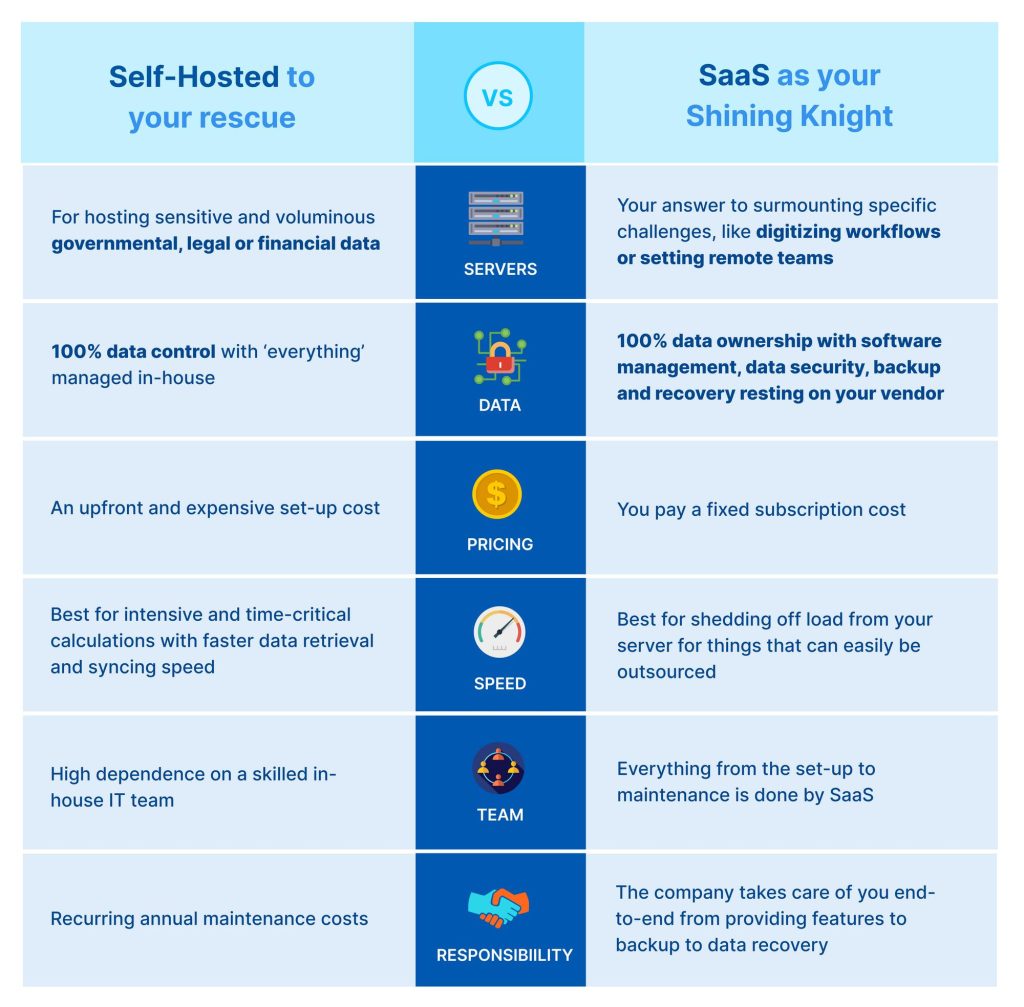
The simplest way to understand the difference is to look at responsibility and control.
With SaaS, the provider manages a large portion of the technology stack.
With self-hosted software, the organization takes on more responsibility in exchange for greater control.
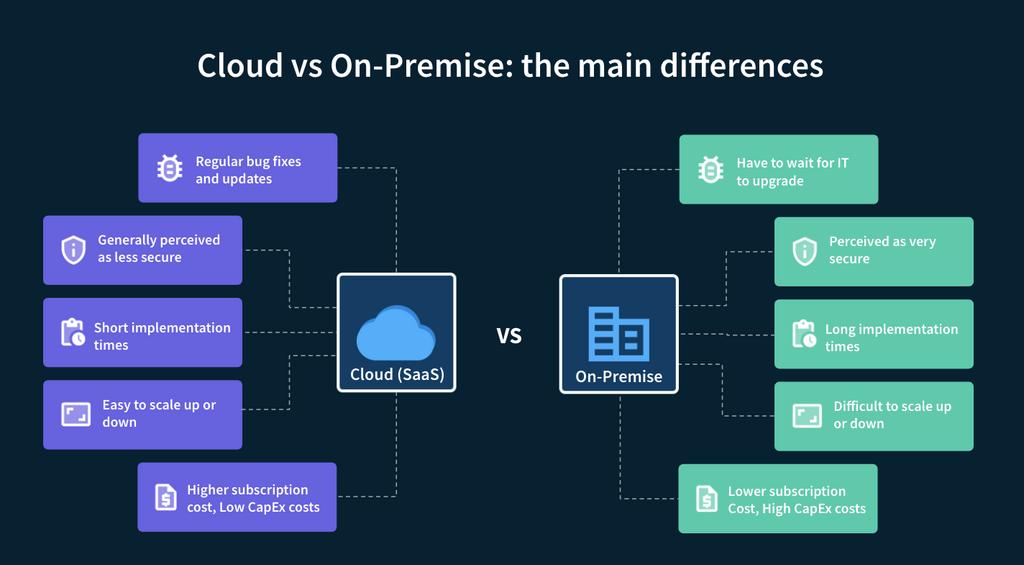
| Factor | SaaS | Self-Hosted |
|---|---|---|
| Infrastructure | Provider-managed | Organization-managed |
| Deployment | Usually faster | Requires technical setup |
| Initial infrastructure cost | Usually lower | Usually higher |
| Maintenance | Mostly provider-managed | Organization-managed |
| Updates | Provider-managed | Organization-controlled |
| Customization | Depends on provider | Generally greater |
| Infrastructure control | Lower | Higher |
| Internal IT requirement | Lower | Higher |
| Accessibility | Usually internet-based | Depends on deployment |
| Data environment control | Provider-dependent | Greater organizational control |
| Scalability | Usually easier to scale | Requires infrastructure planning |
| Software upgrades | Usually managed by provider | Managed by organization |
| Long-term responsibility | Shared/provider-heavy | Organization-heavy |
This table provides the basic distinction, but the real business decision requires looking deeper.
Why Businesses Choose SaaS
SaaS has become popular because it removes many of the technical barriers associated with deploying business software.
1. Faster Implementation
One of the biggest advantages of SaaS is speed.
A business typically does not need to purchase and configure its own server infrastructure before using the application.
Once an account and subscription are established, users can often begin configuring the software and importing business data.
This can significantly reduce the time between software selection and actual usage.
For startups and growing businesses, this can be particularly valuable.
2. Lower Infrastructure Requirements
Traditional software deployments could require businesses to invest in servers, storage, networking equipment, backup systems, and other infrastructure.
With SaaS, much of that infrastructure is operated by the provider.
The business therefore does not need to build the entire technology environment itself.
This does not mean SaaS has no technology costs. Subscription fees are still an ongoing business expense.
However, the cost structure is different.
Instead of making a large infrastructure investment upfront, the organization generally pays for access to the service over time.
3. Easier Maintenance
Software requires continuous maintenance.
Operating systems change. Security vulnerabilities are discovered. Databases require maintenance. Applications receive new versions and features.
With SaaS, much of this responsibility is handled by the provider.
That allows internal teams to spend less time maintaining infrastructure and more time using technology to improve business operations.
4. Easier Scaling
Businesses rarely remain the same size.
The number of employees changes. Customer volumes change. Locations expand. Operational requirements increase.
SaaS platforms are often designed around scalable cloud infrastructure.
Adding users, increasing capacity, or expanding functionality can therefore be easier than purchasing and configuring additional infrastructure manually.
The exact scalability available will depend on the provider and pricing model.
5. Remote Accessibility
Modern businesses often operate across offices, locations, and remote environments.
Because SaaS applications are generally delivered through the internet, employees can access them from different locations and devices, subject to the provider’s access controls and security policies.
This can support distributed teams and multi-location operations.
Why Businesses Choose Self-Hosted Software
Self-hosted software is attractive for a different reason.
Its major advantage is control.
1. Greater Control Over Infrastructure
A business operating its own software environment can make decisions about its infrastructure architecture.
It can determine:
- Where the application is deployed
- How the network is configured
- How access is controlled
- How backups are performed
- How databases are managed
- How monitoring is implemented
For organizations with strong IT capabilities, this level of control can be extremely valuable.
2. Greater Customization
Some businesses operate highly specialized processes.
They may require custom workflows, integrations, data structures, reporting systems, or application behavior that cannot easily be supported by a standard SaaS configuration.
Self-hosted software can provide more flexibility for organizations that need deep customization, although the actual level of customization depends on the software architecture and licensing terms.
3. More Control Over the Data Environment
Data requirements vary considerably between organizations.
Some businesses have strict internal policies regarding where data is stored and how infrastructure is managed.
Others may have regulatory, contractual, or data-sovereignty requirements that influence their deployment decisions.
A self-hosted environment can provide greater control over the underlying data infrastructure.
However, self-hosted does not automatically mean more secure.
Security depends on how the environment is designed, configured, monitored, updated, and maintained.
4. Greater Control Over Updates
SaaS providers generally control when and how software updates are deployed.
That is convenient, but some organizations may require greater control over their upgrade schedules.
Self-hosted deployment can allow businesses to determine when application updates are tested and deployed, depending on the software’s licensing and architecture.
This can be useful when software is deeply integrated into operational systems.
SaaS vs Self-Hosted: Which Is More Secure?
Security is one of the most misunderstood parts of this comparison.
It is tempting to assume that self-hosted software is automatically more secure because the organization controls the environment.
That is not necessarily true.
Security depends on the complete technology environment.
For SaaS, the provider may be responsible for infrastructure security, application security, backups, monitoring, patching, and availability.
For self-hosted software, the organization may need to manage many of these responsibilities itself.
A company with a highly capable IT and security team may be able to operate a strong self-hosted environment.
A small company without dedicated infrastructure and security expertise may actually have a stronger security posture with a reputable SaaS provider.
Therefore, the better question is not:
“Which is more secure?”
It is:
“Which deployment model allows us to maintain the security controls our business requires?”
When evaluating a SaaS provider, businesses should examine areas such as access control, encryption, backups, incident response, authentication, logging, availability, and compliance.
For self-hosted software, businesses should evaluate the same areas while also considering who will operate and secure the infrastructure.
SaaS vs Self-Hosted: What About Cost?
Cost is another area where businesses need to look beyond the obvious price.
SaaS may appear inexpensive because there is often little upfront infrastructure investment.
But subscription costs continue over the life of the service.
Self-hosted software may require greater initial investment, but its cost structure can be different.
A proper comparison should include Total Cost of Ownership (TCO).
SaaS costs may include:
- Subscription fees
- User or usage-based charges
- Premium features
- Integration costs
- Data migration
- Implementation
- Support services
Self-hosted costs may include:
- Software licensing
- Servers or cloud infrastructure
- Storage
- Database infrastructure
- Security tools
- Backup systems
- IT staff
- Maintenance
- Upgrades
- Monitoring
- Disaster recovery
- Technical support
- Custom development
The cheapest option on paper is not necessarily the cheapest option over five years.
Businesses should calculate the expected total cost over the period in which they intend to use the software.
SaaS vs Self-Hosted: What About Customization?
This is one of the areas where the difference can become significant.
SaaS platforms usually provide configuration options within boundaries defined by the provider.
For many businesses, this is enough.
They can configure:
- Users
- Roles
- Workflows
- Forms
- Reports
- Notifications
- Integrations
- Business settings
But businesses with highly specialized requirements may need deeper changes.
Self-hosted software can potentially provide greater flexibility for custom development and infrastructure-level integration.
However, customization also creates responsibility.
Every custom modification has to be maintained, tested, secured, and potentially upgraded in the future.
More customization is not automatically better.
The goal should be to achieve the level of flexibility the business actually needs without creating unnecessary technical complexity.
SaaS vs Self-Hosted for Small Businesses
For many small businesses, SaaS can be the more practical starting point.
Small organizations often want to:
- Launch quickly
- Avoid infrastructure investment
- Reduce IT administration
- Access software remotely
- Scale gradually
- Predict technology expenses
A SaaS platform can address these requirements without requiring the business to build an internal infrastructure team.
However, a small business with specialized compliance requirements, unusual workflows, or existing technical infrastructure may still benefit from self-hosted software.
Business size alone should therefore not determine the decision.
SaaS vs Self-Hosted for Growing Businesses
Growing businesses have a more complicated decision.
At the early stage, SaaS may provide the speed and simplicity the business needs.
As the organization grows, however, requirements can become more sophisticated.
The company may need:
- More integrations
- Advanced reporting
- Complex permissions
- Multiple business locations
- Custom workflows
- Greater infrastructure control
- Data sovereignty
- Enterprise security controls
At this stage, businesses should reassess whether their current deployment model continues to support their operational strategy.
The important point is that software deployment should evolve with the business.
A company does not necessarily have to choose one model forever.
When SaaS Is Probably the Better Choice
SaaS is generally worth considering when your business:
- Wants fast implementation
- Has limited internal IT resources
- Needs remote accessibility
- Wants predictable operational management
- Prefers provider-managed updates
- Wants to avoid managing servers
- Needs to scale users relatively easily
- Does not require extensive infrastructure customization
For these organizations, SaaS can reduce operational complexity and allow teams to focus more heavily on their actual business.
When Self-Hosted Is Probably the Better Choice
Self-hosted software may make more sense when your business:
- Requires extensive customization
- Has a capable internal IT team
- Needs greater infrastructure control
- Has specific data-sovereignty requirements
- Needs control over deployment environments
- Has complex integrations
- Needs greater control over update schedules
- Has specialized security or compliance requirements
The key consideration is whether the additional control justifies the additional operational responsibility.
A Simple Decision Framework
If you are comparing SaaS and self-hosted software, ask these questions before making a decision.
1. How much infrastructure control do we need?
If infrastructure control is not a major requirement, SaaS may be sufficient.
If it is critical, investigate self-hosted options.
2. How much IT capability do we have?
If you do not have the technical resources to maintain servers, databases, security, backups, and monitoring, self-hosting can introduce unnecessary operational risk.
3. How much customization do we actually need?
Separate must-have customization from nice-to-have customization.
Many businesses overestimate how much customization they need before implementation.
4. What are our data requirements?
Identify contractual, regulatory, privacy, security, and data-residency requirements before choosing a deployment model.
5. What is our five-year TCO?
Do not compare only the subscription price with the software license price.
Include infrastructure, people, maintenance, implementation, integrations, backups, support, and upgrades.
6. How quickly do we need to deploy?
If speed is a major priority, SaaS may have an advantage.
7. What will the business look like in three to five years?
Software should support the organization’s future operating model, not just its current requirements.
A Practical Example
Consider a growing service business with 30 employees.
The company needs CRM, invoicing, HR, reporting, and workflow management.
It has a small IT team and employees work from multiple locations.
A SaaS platform could make sense because the company can avoid managing its own application infrastructure and can give employees centralized access to business systems.
Now consider a larger organization with hundreds of employees, complex integrations, strict internal infrastructure policies, and an experienced technology team.
That organization may place greater value on infrastructure control, customization, and deployment flexibility.
A self-hosted model may therefore be worth considering.
Neither organization is making the universally “correct” choice.
They are choosing the model that fits their operating environment.
The Hybrid Approach Is Also an Option
The SaaS vs self-hosted discussion is sometimes presented as if businesses must choose one extreme.
In reality, modern technology environments can be more flexible.
An organization may use SaaS for:
- Collaboration
- Marketing
- Customer relationship management
- Communication
- Productivity
while maintaining self-hosted systems for applications that require greater control.
Some enterprise software providers also offer multiple deployment models, allowing customers to choose between managed cloud environments and self-managed deployments.
This can be particularly useful when different parts of the organization have different technology requirements.
Common Mistakes Businesses Make
Choosing Based Only on Price
The cheapest subscription or license is not necessarily the lowest-cost solution.
Always consider TCO.
Choosing Self-Hosted Because It “Sounds More Secure”
Security depends on implementation.
An unmanaged server with outdated software and weak access controls is not secure simply because it is self-hosted.
Choosing SaaS Without Reviewing the Contract
Businesses should understand data ownership, export capabilities, service availability, support, termination procedures, backup policies, and other contractual terms before committing.
Over-Customizing the Software
Customization should solve a genuine business requirement.
Excessive customization can increase complexity and make future upgrades more difficult.
Ignoring Future Growth
A system that works for ten employees may not be appropriate for 200.
Deployment decisions should consider expected growth.
So, Which Should Businesses Choose?
There is no universal winner in the SaaS vs self-hosted debate.
Choose SaaS when simplicity, speed, scalability, accessibility, and reduced infrastructure responsibility are your priorities.
Choose self-hosted when control, customization, deployment flexibility, and infrastructure ownership are more important—and your organization has the resources to manage them properly.
The decision should ultimately be based on the business, not the technology trend.
Before selecting a software platform, evaluate your requirements across five areas:
Business requirements → Security → Cost → Technical capability → Long-term strategy
If the software meets those requirements, the deployment model becomes a strategic advantage rather than simply a technical preference.
SaaS vs Self-Hosted: Quick Decision Checklist
Ask your team:
- Do we need to deploy quickly?
- Do we have an internal IT team capable of managing infrastructure?
- How much customization do we actually require?
- Do we have specific data-residency or compliance requirements?
- How important is infrastructure control?
- What is our five-year total cost of ownership?
- How many users do we expect to have in the future?
- How critical is remote accessibility?
- Who will manage backups and disaster recovery?
- Who will handle security updates?
- How easily can we migrate our data if we change platforms?
- Does the vendor provide the support and service levels we need?
The answers will usually make the appropriate deployment model much clearer.
Frequently Asked Questions
Is SaaS better than self-hosted software?
Not universally. SaaS is generally more convenient to deploy and manage, while self-hosted software can provide greater control and customization. The better choice depends on the organization’s requirements.
Is self-hosted software more secure than SaaS?
Not automatically. Security depends on architecture, configuration, access controls, monitoring, patching, backups, and operational practices. Both models can be secure when properly implemented.
Is SaaS cheaper than self-hosted software?
SaaS often reduces upfront infrastructure costs, but it typically involves recurring subscription costs. Self-hosted software may require higher infrastructure and operational investment. A total-cost-of-ownership comparison is more useful than comparing only purchase prices.
Can small businesses use self-hosted software?
Yes. However, they should consider whether they have the technical resources required to maintain the environment. For many small businesses, SaaS can reduce this operational burden.
Can a business move from SaaS to self-hosted software?
In some cases, yes. The feasibility depends on the software provider, licensing model, architecture, data-export capabilities, and available self-hosted version.
Can businesses move from self-hosted to SaaS?
Yes, provided the SaaS platform can support the organization’s requirements and the necessary data can be migrated. Migration planning is important because business applications often contain years of operational data.
Key Takeaways
SaaS and self-hosted software represent two different approaches to deploying and managing business technology.
SaaS prioritizes convenience and managed infrastructure.
Self-hosted software prioritizes control and deployment flexibility.
Neither model is inherently superior.
The right decision depends on:
- Your business requirements
- Your technical capabilities
- Your security and compliance needs
- Your customization requirements
- Your total cost of ownership
- Your expected future growth
The best software decision is therefore not simply about asking “Which technology is better?”
It is about asking:
“Which deployment model gives our business the right balance of control, cost, security, flexibility, and operational simplicity?”
That is the question technology decision-makers should answer before selecting their next business software platform.
Related Reading
This article can naturally connect to the existing Migobucks Tech content cluster:
- What Is Digital Transformation?
- What Is Business Automation?
- 10 Business Processes That Can Be Automated
- Why Businesses Outgrow Spreadsheets?
- What Is Generative AI and How Is It Changing Business?
A useful next article in this cluster would be:
“Cloud Computing for Businesses: What You Need to Know Before Moving to the Cloud”
It would create a natural SEO path from Digital Transformation → Business Software → SaaS vs Self-Hosted → Cloud Computing → Business Automation.
Related Topics
Share this post

admin
Published on October 21, 2026 • 16 min read
Discussion 0
No comments yet
Be the first to share your thoughts and join the conversation.
Leave a Comment
Your email address will not be published. Required fields are marked *